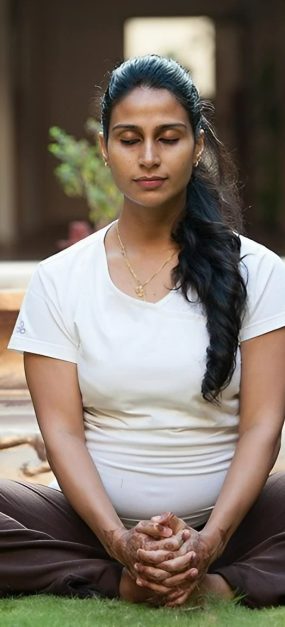


Twenty-four-year-old Meera walked into her first Sri Sri Yoga class with a printout of her hormone report and a face that had clearly given up on smiling.
“I’ve given up sugar, I’m running on a treadmill until my knees ache, and my hormones are still acting like they’re running a chaotic prime-time drama,” Meera complained, slumping onto a yoga bolster at the edge of the hall.
Anjali, an instructor finishing up her morning session, sat down next to her with a warm smile. “Let me guess. A classic case of modern metabolic burnout, mixed with a PCOD diagnosis?”
Meera looked up, shocked. “How did you know? The doctor called it PCOS. Said my insulin is resistant, my ovaries are stressed, and my cortisol is through the roof. I feel like my own body is working against me.”
“It’s not working against you, Meera; it’s just overwhelmed,” Anjali said gently. “PCOS isn’t a disease of the organs; it’s a lifestyle disorder rooted in deep systemic imbalance. In our Sri Sri Yoga classes, we don’t treat symptoms with aggressive workouts. We use specific sequences to calm the nervous system, massage the pelvic region, and reset endocrine communication from the brain down to the ovaries.”
“So, no aggressive cardio?” Meera asked, a hint of relief in her eyes.
“Quite the opposite,” Anjali laughed. “We use conscious breathing and deep pelvic alignment to turn off the body’s alarm system. When stress drops, your hormones follow. Ready to stop fighting your body and start listening to it?”
“Yeah, my gynaecologist said yoga might help with my PCOS,” she told Anjali, “but honestly, I don’t see how sitting on a mat is going to fix my ovaries.”
Anjali smiled. “It’s not going to fix your ovaries directly. It’s going to fix the eighteen-hour workdays, the skipped meals, the 2 a.m. scrolling, and the constant low-grade panic that’s been talking to your ovaries every single day.”
Meera blinked. “That’s oddly specific.”
“That’s most of my Tuesday batch,” Anjali said.
Meera smiled.
Polycystic Ovary Syndrome (PCOS) and Polycystic Ovary Disease (PCOD) affect millions of women worldwide, acting as one of the leading causes of endocrine disruption and fertility challenges today. While the physical symptoms like irregular periods, weight gain, and cystic acne are distressing, the root cause is often metabolic and stress-induced.
This deep-dive guide covers:
- The modern metabolic reality of PCOS and why aggressive lifestyle changes often backfire.
- How the ancient science of yoga targets endocrine imbalance at a cellular level.
- Scriptural insights on female wellness (Shakti) connected to contemporary medical research.
- A practical, verified yoga sequence for PCOS management.
- Common questions answered to help you take charge of your hormonal health.
What did ancient yogic science already understand about this?
The human body was viewed not as a machine with separate parts, but as an expression of Prakriti (Nature) governed by the flow of Prana (vital life force).
Maharishi Patanjali, in the Yoga Sutras, outlines a profound tool for addressing lifestyle disorders:
Heyam Duḥkham Anāgatam
This translates to: “Avoid the suffering that is yet to come.” It encourages proactive management of our health before imbalances manifest as chronic conditions. PCOS is essentially an accumulation of Ama (metabolic toxicity) caused by erratic Dinacharya (daily routines) and heightened emotional stress.
When the flow of Apana Vayu—the sub-dosha of Prana responsible for the downward elimination and reproductive functions in the pelvic floor—becomes blocked, hormonal gridlocks occur. Apana Vayu is the downward-flowing energy that governs elimination, menstruation, and reproductive function, seated in the pelvic floor and lower abdomen. Multiple yogic and Ayurvedic sources describe Apana Vayu as responsible for menstruation, childbirth, and the healthy release of what the body no longer needs, and note that its disruption, often through excess stress, overthinking, or an ungrounded lifestyle, shows up as menstrual irregularity and pelvic tension. This is precisely why grounding, hip-opening postures and slow, deliberate exhalation form the backbone of yoga therapy for PCOS. It isn’t a modern invention layered onto an old practice; it’s the original logic of the practice being applied to a modern problem.
Gurudev Sri Sri Ravi Shankar captures the underlying mechanism simply: “Every emotion is connected with the breath. If you change the breath, change the rhythm, you can change the emotion.” For a condition so deeply intertwined with the stress response, that single principle is arguably the most clinically relevant thing anyone has said about it in a sentence.
How Does Yoga Help Regulate PCOS?
To understand how yoga aids in managing PCOS, we must look beyond basic stretching. The practice works on the endocrine system through direct physical stimulation and autonomic nervous system regulation.
1. Pelvic Circulation and Decongestion
Sitting for prolonged hours restricts blood flow to the reproductive organs. Forward bends, twists, and hip-opening postures create local intra-abdominal pressure. When a posture is released, it triggers a rush of fresh, oxygenated, nutrient-rich blood to the uterus and ovaries, helping to clear stagnant energy.
2. Lowering Cortisol and Insulin Resistance
High stress yields high cortisol, which directly causes the body to store fat and reject insulin. Yogic practices switch the body from the sympathetic (“fight-or-flight”) nervous system to the parasympathetic (“rest-and-digest”) state. Lower cortisol levels allow cells to process glucose more effectively, mitigating insulin resistance.
3. Activating the Thyroid and Pituitary Glands
Inversions and throat-stimulating poses modify the pressure gradient in the upper torso. This mild pressure helps regulate the pituitary gland—the master control switch for the hormonal signals sent directly to the ovaries.
To truly understand how these systems link together, joining formal programs like the Sri Sri School of Yoga can help you transition from random online tutorials to a deeply personalized, scientifically grounded daily sadhana.
Can specific yoga poses actually help manage PCOS symptoms?
Yes, and each pose earns its place for a specific physiological reason, not because it “feels gentle.”
| Asana | How It Helps With PCOS |
| Baddha Konasana (Butterfly Pose) | Increases blood circulation to the pelvis and ovaries, and gently opens the hips where tension often accumulates |
| Supta Baddha Konasana (Reclining Butterfly) | The reclined version deepens relaxation and lowers cortisol more than the seated variant, useful given PCOS’s strong stress link |
| Bharadvajasana (Seated Spinal Twist) | Stimulates and gently massages the abdominal organs, supporting digestion and detoxification pathways |
| Chakki Chalanasana (Mill Churning Pose) | Massages the liver, kidneys, pancreas, and reproductive organs directly through its churning motion |
The Essential Addition: Kapalbhati and Nadi Shodhan
No PCOS protocol is complete without breath regulation. Kapalbhati Pranayama (Skull Shining Breath) involves powerful, active exhalations that act as an internal massage for the abdominal organs, helping to clear metabolic toxins and improve pancreatic function.
Following this with Nadi Shodhan (Alternate Nostril Breathing) restores equilibrium to the nervous system, clearing mental fatigue and balancing the endocrine outputs. It balances the autonomic nervous system, lowering the sympathetic “fight or flight” activity that keeps cortisol elevated
Bhramari Pranayama (Bee Breath) activates the parasympathetic nervous system almost immediately, useful for the mood swings and anxiety that often accompany PCOS
Gurudev Sri Sri Ravi Shankar captures the underlying mechanism simply: “Every emotion is connected with the breath. If you change the breath, change the rhythm, you can change the emotion.” For a condition so deeply intertwined with the stress response, that single principle is arguably the most clinically relevant thing anyone has said about it in a sentence.
What lifestyle habits make the biggest difference alongside yoga?
Yoga works best as part of a fuller picture, not a standalone fix. Prioritising whole, unprocessed food over packaged snacks supports insulin sensitivity directly. Consistent sleep timing helps regulate the same hormonal axis that governs ovulation. Ten minutes of daily pranayama, done consistently, tends to outperform an hour of yoga done once a week, since the nervous system responds to rhythm, not intensity. And tracking your cycle, weight, and mood honestly, without obsessing over it, gives both you and your doctor real data to work with.
If you’d like to see some of these techniques in practice, the Sri Sri School of Yoga YouTube channel features guided sessions worth exploring alongside a proper class.