

In a world where stress and anxiety have become woven into everyday life, ancient yogic practices are offering a grounded, time-tested path back to balance. Recent global surveys show that 62% of people experience stress that affects their daily functioning, while 43% of American adults report feeling more anxious than they did the previous year.
Amid this rising emotional burden, yoga and breathwork are receiving growing scientific attention. One practice in particular — Bhramari Pranayama, also known as the humming bee breath — is emerging as both gentle and remarkably effective for calming the nervous system.
In this comprehensive guide, you’ll discover:
- The ancient origins and scientific validation of Bhramari Pranayama
- Step-by-step instructions for proper practice
- Evidence-based health benefits backed by clinical research
- How this technique produces 15-fold increases in nitric oxide
- Common mistakes to avoid and expert tips for deepening your practice
- How Sri Sri School of Yoga integrates this wisdom into transformative teacher training
What Is Bhramari Pranayama?
Etymology and Ancient Roots
Bhramari Pranayama derives its name from the Sanskrit word “Bhramari,” meaning the large black Indian bee. This breathing technique mimics the gentle humming sound of a bee, creating therapeutic vibrations throughout the body and mind.
The Hatha Yoga Pradipika, a classic 15th-century yoga text by Swami Swatmarama, describes the technique: “Breathe in quickly, making a reverberating sound like the male black bee, and exhale slowly while softly making the sound of the female black bee. By this yogic practice, one becomes Lord of the Yogis and the mind is absorbed in bliss” (Chapter 2, Verse 68).
This practice appears in several ancient texts including the Gheranda Samhita and various Saivagama texts, underscoring its significance in traditional yoga lineages. Categorized as one of the eight classical Kumbhakas (breath retention practices) in Hatha Yoga, Bhramari enables practitioners to hear the unstruck sound (Anahata) rising from the heart.
The Modern Relevance of Ancient Wisdom
What ancient yogis understood intuitively, modern science is now validating through rigorous research. The connection between breath, mind, and body that forms the foundation of Bhramari Pranayama aligns perfectly with contemporary understanding of the nervous system, neuroplasticity, and psychoneuroimmunology.
“Breath is the link between the body and mind. If the mind is a kite the breath is the thread. The longer the thread, the higher the kite can go.”
— Gurudev Sri Sri Ravi Shankar
At Sri Sri School of Yoga, this ancient-modern synthesis forms the cornerstone of our teaching methodology, where traditional practices are taught with scientific precision and contemporary relevance.
How Does Bhramari Pranayama Work?
The Science Behind the Humming
The unique power of Bhramari Pranayama lies in its multifaceted mechanism of action:
1. Nitric Oxide Production
The most remarkable scientific discovery regarding hummingbirds relates to their production of nitric oxide (NO). Research shows that humming increases the endogenous generation of nitric oxide level by 15-fold compared with quiet exhalation. This Nobel Prize-winning molecule acts as:
- A powerful vasodilator improving blood flow
- An antimicrobial and antiviral agent
- A regulator of immune function
- A facilitator of oxygen uptake in tissues
Study: Modified Bhramari Pranayama in Covid 19 Infection
2. Parasympathetic Activation
Studies show that Bhramari Pranayama practice demonstrates parasympathetic dominance, meaning it activates the “rest and digest” response of the autonomic nervous system. This counteracts the chronic stress response plaguing modern society.
Research Reference: Effects of Bhramari Pranayama on health – A systematic review
3. Neurological Benefits
The vibrations created during humming produce measurable changes in brain activity. Bhramari pranayama has been found to have positive effects on psychological, cardiovascular and pulmonary health, with impacts on attention, emotional regulation, and cognitive function.
Study: Comprehensive literature review on Bhramari benefits
What Are the Proven Health Benefits?
Mental Health and Emotional Well-Being
Stress Reduction
In today’s high-stress environment where 31% of adults worldwide consider stress the biggest health problem in their country, Bhramari offers immediate relief. A study on COVID-19 patients showed significant reduction in Depression Anxiety and Stress Scale-21 (DASS-21) scores after just 15 days of practice.
Research: Bhramari intervention study on COVID patients
Anxiety and Depression
Research published in PMC demonstrates that Bhramari Pranayama practice improves cardiovascular parameters through parasympathetic dominance in adolescents, making it particularly valuable for young people navigating mental health challenges.
Study: Immediate Effects of Bhramari on Cardiovascular Parameters
Cardiovascular Health
Blood Pressure Management
A randomized clinical trial found that both Nadi Shodhana and Bhramari Pranayama can be effective in balancing the sympathovagal tone, making them valuable for essential hypertension management.
Research: Bhramari Pranayama effects on hypertensive patients
Heart Rate Variability
Research demonstrates significant reduction in heart rate (HR), increase in heart rate variability (HRV), and increase in lung function after 10-20 minutes of daily practice for at least 4-6 weeks.
Study: Bhramari as lifestyle intervention
Respiratory Health
Enhanced Lung Function
The increased nitric oxide production during humming has profound respiratory benefits. Studies show that Bhramari pranayama is effective in relieving symptoms of chronic rhinosinusitis, with significant improvement seen as early as 2 weeks.
Research: Bhramari efficacy in chronic rhinosinusitis
COVID-19 and Respiratory Support
During the pandemic, Bhramari’s ability to enhance nitric oxide expression and increase carbon dioxide through extended exhalation was explored as a supportive practice for preventing coagulopathies associated with COVID-19.
How to Practice Bhramari Pranayama: Step-by-Step Guide
Preparation
- Choose Your Environment: Find a quiet, well-ventilated space where you won’t be disturbed
- Timing: Practice on an empty stomach, ideally early morning or evening
- Posture: Sit comfortably in Sukhasana (Easy Pose), Padmasana (Lotus Pose), or on a chair with spine erect
Classical Technique (with Shanmukhi Mudra)
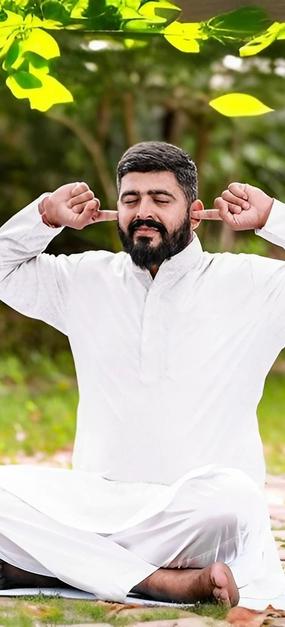
Step 1: Hand Position
- Close your eyes gently
- Place your thumbs on the tragus (small cartilage) of each ear or gently press to close the ear canal
- Rest your index fingers lightly on your forehead
- Place the middle fingers gently on closed eyelids
- Ring fingers rest near the nostrils
- Little fingers near the upper lip
Step 2: Breathing Pattern
- Inhale deeply and slowly through both nostrils
- As you exhale, make a steady humming sound like a bee (mmmmm…)
- Keep your mouth closed; the sound should resonate through your nasal passages
- Focus your attention on the center of your forehead (Ajna Chakra)
- Complete one round
Step 3: Duration
- Beginners: 5 rounds initially
- Intermediate: 10-15 rounds
- Advanced: 20-30 rounds or 5-15 minutes
Simplified Variation
For those new to the practice or with physical limitations:
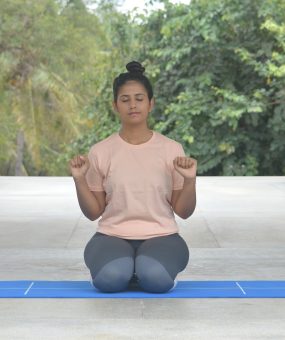
- Simply sit comfortably with eyes closed
- Hands can rest on knees in Gyan Mudra (thumb and index finger touching)
- Focus on producing a gentle, steady humming sound on exhalation
- No hand mudra required
What Mistakes Should You Avoid?
| Common Mistake | Correction |
| Humming too loudly or forcefully | Keep the sound gentle and steady; it should be soothing, not straining |
| Pressing too hard on ears or eyes | Use gentle pressure; you’re creating a seal, not compressing |
| Rushing the breath | Allow natural, slow breathing; don’t force longer exhalations |
| Practicing immediately after meals | Wait 2-3 hours after eating |
| Holding tension in shoulders/neck | Keep upper body relaxed throughout |
| Irregular practice | Consistency is key for benefits; daily practice is ideal |
Who Should Practice and Who Should Avoid?
Ideal For:
- Anyone experiencing stress, anxiety, or depression
- Individuals with high blood pressure (under guidance)
- Those with sleep disturbances
- People with respiratory conditions (chronic sinusitis, mild asthma)
- Students and professionals seeking improved focus
- Anyone looking to deepen meditation practice
Contraindications and Precautions:
- Ear infections: Avoid until resolved
- Severe heart conditions: Consult a physician first
- Active sinus infection with severe pain: Wait until the acute phase passes
- Pregnancy: Use simplified version without Shanmukhi Mudra; consult a qualified instructor
- Epilepsy: Practice only under expert supervision
“Our breath is linked to our emotions. For every emotion, there is a particular rhythm in the breath. So, when you cannot directly harness your emotions, with the help of breath, you can do that.”
— Gurudev Sri Sri Ravi Shankar
Bhramari Pranayama in the Context of Traditional Yoga
Integration with the Eight Limbs of Yoga
While the Hatha Yoga Pradipika deals with pranayama, mudras and meditation, Bhramari uniquely bridges these practices. The technique combines:
- Pranayama (breath control)
- Mudra (Shanmukhi hand gesture)
- Pratyahara (sensory withdrawal by closing eyes and ears)
- Dharana (concentration on the sound and Ajna Chakra)
This makes it an exceptionally complete practice, suitable for both beginners and advanced practitioners.
Beyond Physical Practice: Nadanusandhana
In Hatha Yoga Pradipika, Nadanusandhana (sound meditation practice) is given independent importance, and in Gheranda Samhita, it is placed under Bhramari Kumbhaka. This connection to inner sound meditation elevates Bhramari from mere breathing exercise to a gateway for deeper consciousness exploration.
At Sri Sri School of Yoga, we honor the ancient wisdom of texts like the Hatha Yoga Pradipika while incorporating contemporary research. Students learn both the traditional technique and understand the modern science.
Understanding that each body is unique, our certified teachers guide students in adapting the practice to their specific needs, whether for stress management, cardiovascular support, or spiritual development.
Real-World Application
Students learn not just how to practice but how to integrate Bhramari into daily life—at work, before important meetings, during moments of anxiety, or as part of a comprehensive wellness routine.
Frequently Asked Questions (FAQ)
1. How long does it take to see benefits from Bhramari Pranayama?
Many practitioners report immediate calming effects after just one session. However, research shows significant improvement in symptom scores within 2 weeks of regular practice. For deeper transformations in cardiovascular health and autonomic function, 4-6 weeks of consistent daily practice is recommended.
2. Can I practice Bhramari Pranayama if I’m a complete beginner?
Absolutely! Bhramari is one of the most accessible pranayama techniques. Its simplicity—with no breath holding or alternate nostril involvement—makes it easily practiced by everyone irrespective of age or gender. Start with just 3-5 rounds and gradually increase.
3. What’s the best time of day to practice?
Early morning (before breakfast) and evening (before dinner) are ideal times. Morning practice energizes while calming the mind for the day ahead, while evening practice helps release accumulated stress and prepares you for restful sleep. Avoid practicing immediately after meals.
4. Should I practice with or without Shanmukhi Mudra?
Both variations are beneficial. The classical technique with Shanmukhi Mudra (closing the senses) creates deeper sensory withdrawal and enhances concentration. The simplified version without hand mudra is excellent for beginners, those with limited hand mobility, or practice in public/work settings.
5. Can Bhramari help with insomnia?
Yes. Scientific research has recommended slow breathing as adjunctive therapy for insomnia, and regular Bhramari practice demonstrates positive impact on both sleep quality and the autonomic nervous system via increased parasympathetic dominance.
6. Is it normal to feel vibrations in my head during practice?
Yes, this is completely normal and actually beneficial. The vibrations created by humming stimulate various regions of the brain and sinuses. According to Ayurveda, Bhramari is designed to create vibration in the skull/brain and chest/heart and connect the two, facilitating the integration of thought and feeling.
7. How is Bhramari different from other pranayama techniques?
Unlike forceful techniques like Bhastrika or complex patterns like Nadi Shodhana, Bhramari’s gentle humming makes it uniquely soothing and accessible. The self-induced humming sound resembles mantra repetition technique, adding a meditative quality. It’s particularly effective for those who find other breathwork challenging.
8. Can children practice Bhramari Pranayama?
Yes, children as young as 5-6 years can practice a simplified version. The bee-like sound makes it fun and engaging for children, helping them develop body awareness, emotional regulation, and concentration skills. Always supervise children during practice.
9. Will Bhramari interfere with my medications?
Bhramari is generally complementary to medical treatment, not a replacement. Studies show Bhramari can be practiced for management of essential hypertension, but those on medications should consult their healthcare provider before beginning practice and never discontinue prescribed medications without medical supervision.
10. How can I deepen my Bhramari practice?
To deepen your practice:
- Maintain consistency (daily practice at the same time)
- Gradually extend exhalation duration without strain
- Cultivate inner listening to the sound vibrations
- Combine with meditation after completing rounds
- Consider learning from qualified teachers who can provide personalized guidance
For comprehensive training in Bhramari and other transformative practices, explore the Sri Sri Yoga Teacher Training programs where ancient wisdom meets modern pedagogy.
Your Next Step: Sri Sri Yoga Teacher Training
Whether you’re seeking personal transformation or aspiring to guide others on their wellness journey, the Sri Sri School of Yoga Teacher Training offers an unparalleled opportunity to:
Master Authentic Techniques: Learn Bhramari and comprehensive pranayama sequences directly from the lineage of Gurudev Sri Sri Ravi Shankar, grounded in both ancient texts and contemporary science.
Develop Teaching Excellence: Gain the skills to adapt practices to diverse populations—from corporate stress management to therapeutic applications for specific health conditions.
Join a Global Community: Connect with like-minded seekers and experienced teachers from around the world, creating lasting relationships and support networks.
Transform Personally While Training: Experience profound shifts in your own health, emotional well-being, and consciousness as you deepen your practice.
Create Meaningful Impact: Equip yourself to share these life-changing practices authentically, whether teaching full-time, integrating yoga into other health professions, or simply living more consciously.
The breath you take right now is a bridge between your body and mind, between ancient wisdom and modern life, between where you are and where you could be. Bhramari Pranayama—with its gentle humming reminiscent of bees pollinating flowers—invites you to cross that bridge.
Are you ready to transform stress into serenity, anxiety into awareness, and knowledge into lived wisdom?
Begin your journey today. Your breath is waiting.
[Learn more about Sri Sri Yoga Teacher Training]
Disclaimer: This article is for educational purposes only and is not a substitute for medical advice. Individuals with health conditions should consult qualified healthcare professionals before beginning new practices. Always learn pranayama under the guidance of a certified yoga teacher.